
The Shower Effect: Why Your Best Ideas Appear When You’re Doing Less
Aug 11, 2026
Why on earth is it that the moment I step into the shower, start walking, or sit behind the wheel, ideas suddenly begin flooding in, usually at the exact time I don’t have a notepad, my phone battery is low, or I’m halfway through something I can’t stop doing?
It’s frustrating in a very particular way, because it feels like my brain has chosen the least convenient possible moment to become productive.
And yet, over time, I’ve learned something important: not all ideas deserve immediate attention, but many of them deserve to be noticed.
Jack Delosa once joked that when he has an idea, he takes a Panadol and hopes it goes away, and while that line always makes me laugh, it also points to a deeper truth: ideas are easy to generate, but knowing when and how to work with them is what actually matters.
What’s really happening when ideas appear out of nowhere
Psychologists have studied this phenomenon for years and often refer to it as the “shower effect.”
A term used to describe how creative insights tend to surface during low-effort, everyday activities such as showering, walking, or driving.
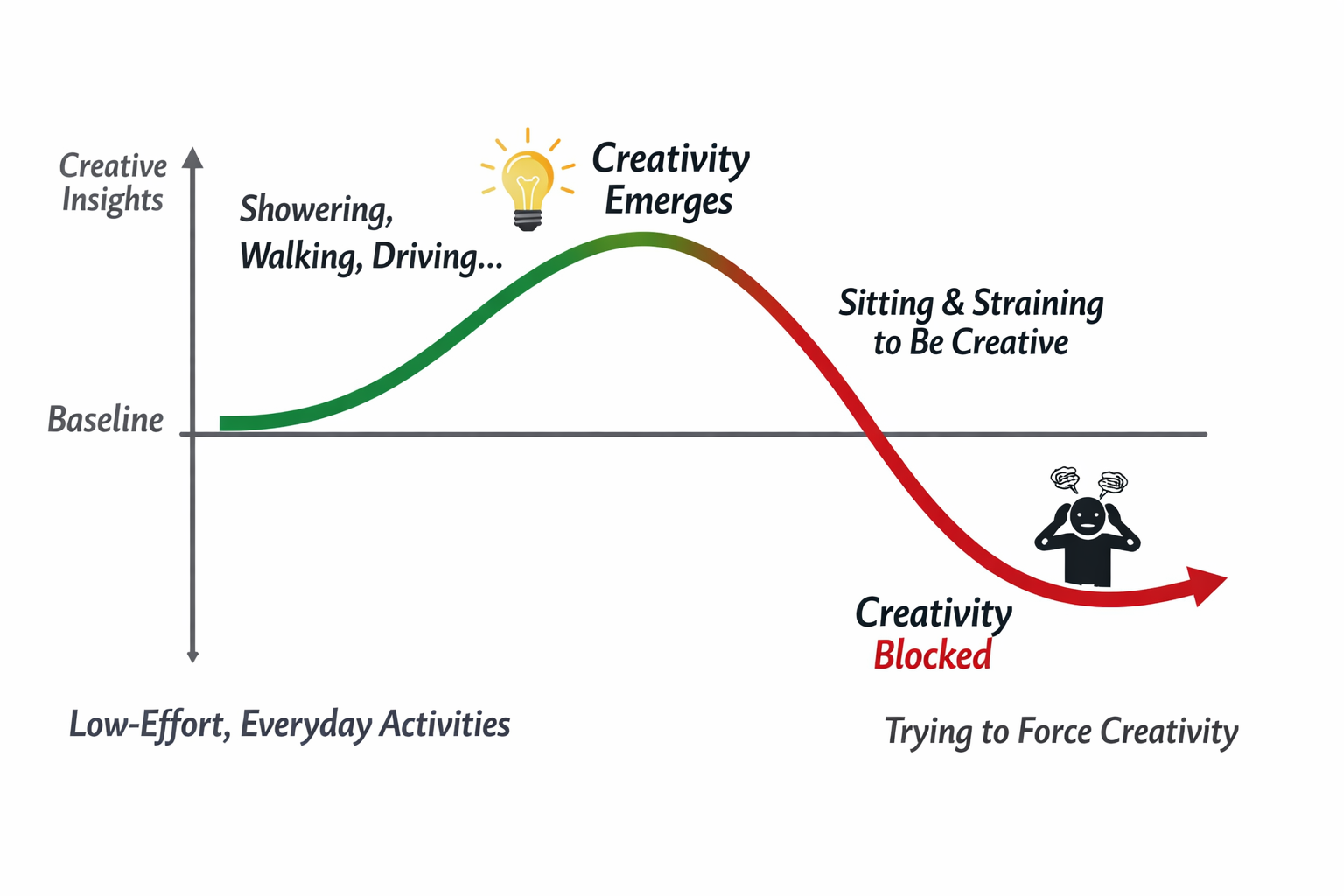
The reason lies in how the brain balances attention.
Research in cognitive psychology shows that creativity is most likely to emerge when the mind is moderately engaged, not bored, but not under pressure, because this state allows thoughts to wander while remaining loosely connected to the task at hand.
In one well-known experiment, participants were asked to complete a creativity task involving alternative uses for everyday objects and were then given an incubation period where one group watched a deliberately dull video of someone folding laundry, while another watched a more engaging scene from When Harry Met Sally.
The group exposed to the less demanding task consistently produced more creative ideas afterward, suggesting that creativity doesn’t thrive under intense focus, but in the mental space between effort and ease.
What the data tells us
In a 2012 study led by cognitive psychologist Benjamin Baird, participants whose minds were allowed to wander during a moderately engaging activity generated up to 40% more creative solutions than those who stayed fully focused or completely disengaged.
A separate Stanford study found that walking increased creative output by an average of 60%, regardless of whether participants walked indoors or outdoors, reinforcing the idea that physical movement paired with low cognitive demand creates ideal conditions for idea generation.
Neuroscience helps explain why this happens.
Brain-imaging research shows that during low-effort activities, the brain’s default mode network becomes more active, a network strongly associated with imagination, memory integration, and creative insight, allowing ideas to connect in ways that don’t easily occur when we’re trying too hard to think.
Why forcing ideas often backfires
This research also explains why staring at a blank screen and demanding inspiration so often leads nowhere.
When we push ourselves to produce ideas on command, the brain shifts into evaluation mode rather than generation mode, filtering thoughts before they’ve had time to form, which is why clarity feels so elusive when effort is highest.
Creativity, it turns out, is less about pressure and more about conditions.
Too dull, and the mind drifts without direction. Too demanding, and attention narrows so tightly that new associations struggle to emerge.
How to work with your brain instead of against it
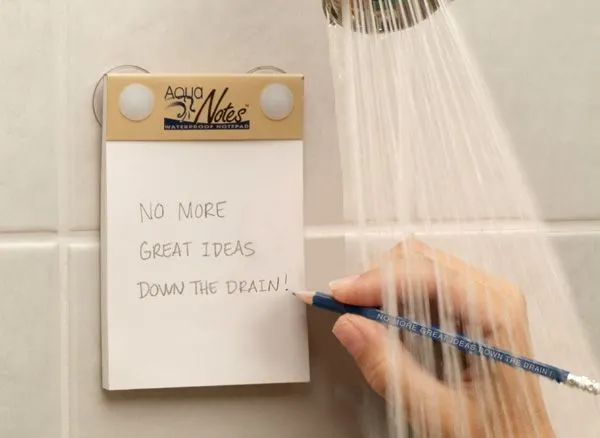
When ideas show up at inconvenient times now, I don’t try to refine them or judge whether they’re good, useful, or worth pursuing.
I capture them quickly and imperfectly knowing that the goal is to give it somewhere safe to land so I can return to it later...
-
a voice memo while driving,
-
a half-formed sentence in my notes app,
-
a scrap of paper left on the kitchen bench.
Over time, this has changed my relationship with creativity from something I try to force on demand to something I learn to notice and support.
The real takeaway
If you’re stuck on your next piece of content, the answer may not be to think harder, plan more, or sit at your desk for longer, but to change the conditions under which you’re trying to think.
Sometimes the most productive thing you can do is step away, loosen your attention, and let your mind do the quiet work it’s already capable of doing.
A question worth sitting with
When you feel creatively blocked, do you give yourself space to wander first, or do you expect clarity before your brain has had the chance to find it?
Do you have a sales or landing page?
Tired of getting traffic but not enough sales?
Then this is for you.
Conversion Magic: our self-paced course for entrepreneurs wanting to scale their digital offers.
Packed with powerful sales & marketing psychology tactics (from running millions of $ in ads) proven to increase conversions.