The Psychology of Jam: Why Too Many Choices Kill Your Sales
Feb 04, 2026
Years ago, behavioural economists Sheena Iyengar and Mark Lepper set up a simple experiment in a California supermarket.
They wanted to understand one thing: Does more choice help people make better decisions… or does it quietly push them away?
So they set up two tasting tables:
- - One with 24 flavours of jam.
- - One with just 6 flavours.
You can probably guess which table attracted more people.
The 24-jam table pulled a crowd. It was colourful, exciting, the kind of display that makes you think the store really cares about variety.
But when it came to buying, something surprising happened.
The table with 6 flavours outsold the bigger display by a factor of ten.
Not 10%. Ten times more sales.
This became one of the most cited behavioural studies in marketing because it revealed a truth we still underestimate today:
People love browsing options, but they buy from clarity.
Why the “jam effect” happens
Choice feels empowering in theory. In practice, too much choice forces the brain into a cognitive bottleneck.
Here’s what’s happening neurologically:
1. Decision fatigue sets in fast
Every option costs mental energy. Psychologist Roy Baumeister’s research shows that the more decisions you make in a day, the worse your decision quality becomes even with small choices.
(Have you noticed that people like Steve Jobs, Mark Zuckerberg, and Giorgio Armani always wear the same outfit?)
2. The brain fears losing out
This is loss aversion. More options = more potential to choose the “wrong” one. So the mind delays the decision to reduce risk… which often becomes no decision at all.
3. Working memory collapses under too many inputs
Your brain can only hold about 3–4 pieces of information at once (MIT research). Anything beyond that feels overwhelming and pushes people into avoidance.
4. Choice overload reduces satisfaction
Iyengar later found that even when people do choose from a large set of options, they feel less happy with their choice. More variety equals more second-guessing.
So it’s not that customers don’t want your offer. They simply don’t have the cognitive space to process it.
What this means for your marketing
Most struggling landing pages and sales funnels have the same issue:
- - Too many paths.
- - Too many buttons.
- - Too many “maybes.
When clarity disappears, so does momentum. Here’s what the data suggests works better:
✔ One core CTA (not three competing ones)
Removing secondary options can increase conversions by up to 17% (MarketingExperiments).
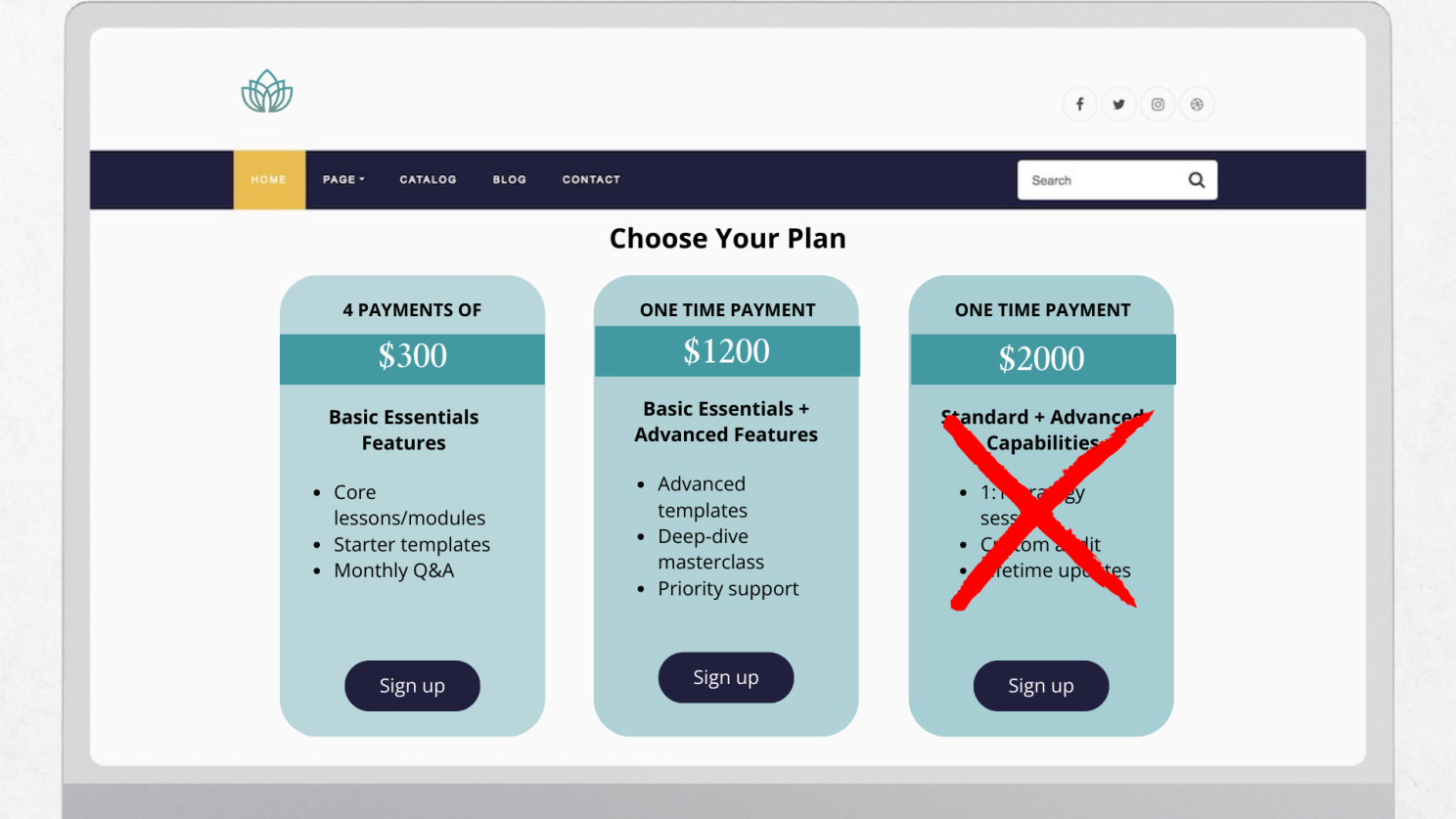
✔ Fewer pricing tiers
A study from the Journal of Consumer Research found that buyers are more satisfied and convert higher, when offered two to three pricing options.
✔ Simplified product assortments
Psychologist Barry Schwartz’s work on The Paradox of Choice shows that reducing product variety actually increases both sales and customer happiness.
When you narrow the path, the brain relaxes. And a relaxed brain buys.
The real lesson of the jam study
It’s tempting to think that success comes from offering more, showing more, adding more.
But in reality? People choose the brand that reduces their mental load not the one that expands it.
Clarity converts, simplicity reassures and fewer choices create the momentum your customers need to take action.
Do you have a sales or landing page?
Tired of getting traffic but not enough sales?
Then this is for you.
Conversion Magic: our self-paced course for entrepreneurs wanting to scale their digital offers.
Packed with powerful sales & marketing psychology tactics (from running millions of $ in ads) proven to increase conversions.